 Ultimate guide
Long Term Recovery Strategies for Adult Physical Rehabilitation
Last Updated: 12 November 2026
Quick Summary
Long term recovery strategies for adult physical rehabilitation are structured, sustained approaches that carry functional gains beyond the first few months of formal therapy and into everyday independence. They work by tying goals to daily activities, planning in overlapping phases from early recovery to maintenance, and reviewing progress regularly so the plan is adjusted when things stall.
- Improvements can continue for months or even years after a formal rehabilitation programme ends.
- In early recovery, use short and frequent sessions of two or three ten-minute blocks a day.
- Maintenance from month six onwards is lighter but does not stop, such as two strength sessions a week.
- Before discharge, ask which exercises to continue, who reviews progress and what prompts a re-referral.
- After a setback, restart at roughly half the previous volume for the first week, then build back up.
Table of Contents
- Why Long Term Recovery Strategies Matter in Adult Physical Rehabilitation
- Setting Rehabilitation Goals for Adults That Hold Up Over Time
- Building a Long-Term Rehabilitation Plan Around Real Life
- Physical Rehabilitation Exercises for Adults You Can Sustain
- Recovery After Hospital Discharge: The First Weeks and Beyond
- Measuring Progress and Adjusting the Plan When Things Stall
- Staying Motivated, Preventing Setbacks and Knowing When to Seek Review
- Getting a Recovery Plan Built Around Your Daily Life
- Frequently Asked Questions
Why Long Term Recovery Strategies Matter in Adult Physical Rehabilitation
Long term recovery strategies for adult physical rehabilitation are the structured, sustained approaches that carry functional gains beyond the first few months of formal therapy and into everyday independence.
Physical rehabilitation restores movement, strength and daily function after injury, illness or surgery through therapeutic exercise, mobility training and task practice.
Below, we set out how to build recovery goals that hold, how to structure a long-term rehabilitation plan around real life, and how to measure progress and adjust when things stall.
Setting Rehabilitation Goals for Adults That Hold Up Over Time
Rehabilitation goals for adults last when tied to a daily activity the person cares about, not a clinical measure alone.
A common mistake is setting goals that are ambitious but untestable. Pair every goal with a way to check it:
- Functional goal: return to cooking a simple meal standing up
- Measure: can you stand at the hob for ten minutes without sitting?
- Review point: reassess in four weeks
Personalised care works because it accounts for the whole person: home layout, work, caring responsibilities and confidence. Our guide to personalised rehabilitation planning explains how goals are built for children, young people and adults so they support independence rather than just exercise compliance.
Building a Long-Term Rehabilitation Plan Around Real Life
A long-term rehabilitation plan is a written schedule that maps exercises, daily activity practice and review points across weeks and months, built around existing routines. Our guide on how to structure home rehabilitation plans explains how to build one around meaningful routines, safe progress and shared goals. What separates a plan that holds from one that fades is not the number of exercises but whether it specifies phases, review points and criteria for moving between them.
Phased goals: from early recovery to everyday independence
A workable long-term plan can be thought of in overlapping phases, because the maintenance phase is where gains are kept or lost.
Phase 1, Early recovery (roughly weeks 0-6 after discharge). The focus is safe movement, rebuilding strength with support, and re-establishing a daily routine. Sessions are short and frequent, often two or three ten-minute blocks a day rather than one long session, because fatigue is high and tolerance is low. Review may be weekly, depending on the service involved. The criterion for moving on is consistent, safe completion of the current routine with no increase in pain or fatigue, not a calendar date.
Phase 2, Building capacity (roughly weeks 6-12). Balance, walking practice and activities of daily living such as dressing, cooking and managing stairs are added.
Phase 3, Community participation (roughly months 3-6). The plan shifts towards return to work, hobbies, caring responsibilities and confidence outside the home.
Phase 4, Maintenance (month 6 onwards). The aim is to keep what has been gained. Maintenance is usually lighter, two strength sessions a week, daily walking, and periodic checks of balance and daily-living tasks, but it does not stop. A common pattern is for people to drop the programme once they feel better, then lose ground over the following months. Building maintenance into the week as a fixed habit prevents that drift.
Coordinating NHS, community and private support
Continuity of care is where long-term plans most often break down, so be explicit about who does what.
Beyond formal therapy, the plan can draw on several sources of support. Community groups, leisure centre classes adapted for older or disabled adults, and walking groups provide the social contact that sustains exercise. Private occupational therapy or physiotherapy is one option for people who want a plan reassessed after formal therapy ends.
Making the plan fit different adult lives
A plan that ignores work, caring responsibilities, housing and personal priorities will not survive contact with a real week.

Watch out: a plan that is copied from a leaflet or a website without adjustment to the person's home, work and baseline is the most common reason a long-term programme stalls in the first month.
Physical Rehabilitation Exercises for Adults You Can Sustain
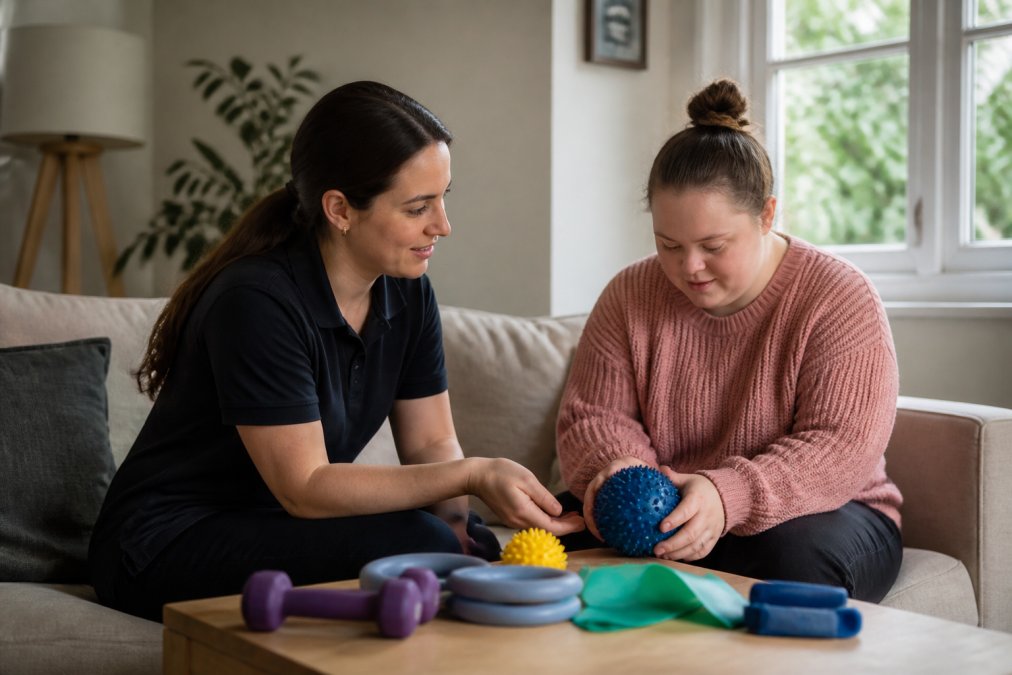
Physical rehabilitation exercises for adults only work if they are sustainable, which means low equipment, short sessions and a clear progression. The aim is consistent practice rather than occasional effort, and home exercise can make up much of that practice.
Strength, balance and walking practice at home
Build a weekly routine around three pillars:
- Strength training: sit-to-stand from a firm chair, wall press-ups, and light resistance band work for the arms, two to three times a week.
- Balance: standing on one leg holding a worktop, heel-to-toe standing, and side-stepping along a counter, daily where safe.
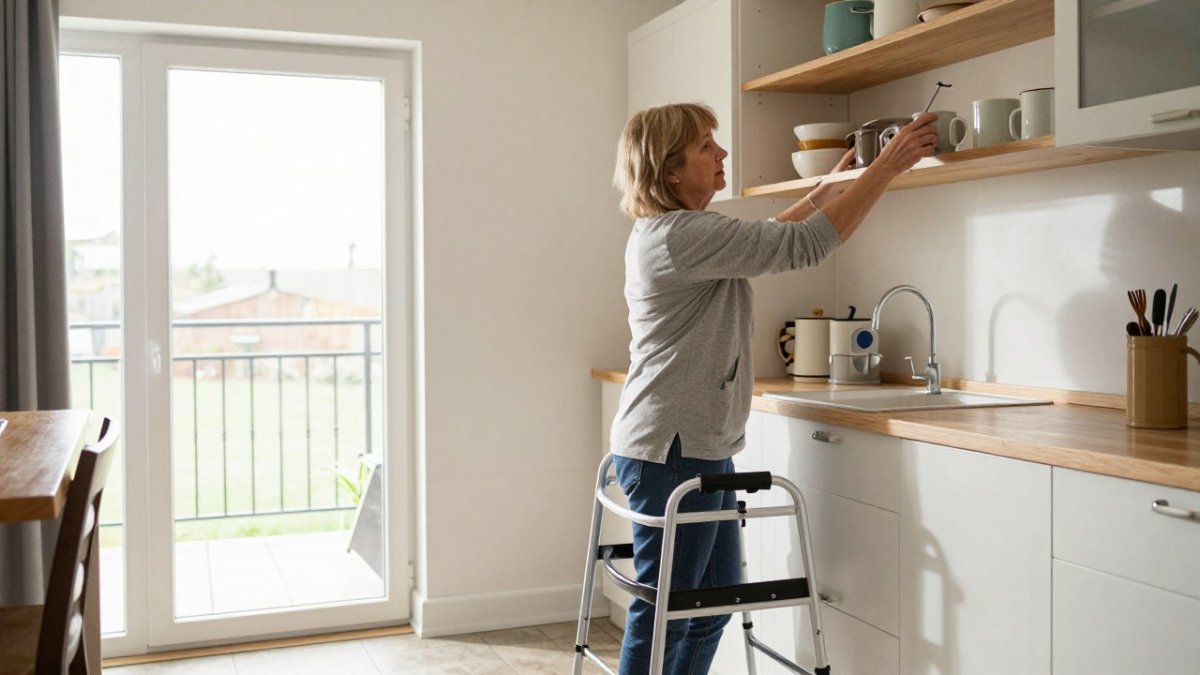
- Walking and movement practice: short, frequent walks with a walking aid if needed, plus practice on stairs and uneven ground with supervision.
Joint protection and pacing matter as much as the exercises themselves. Adding load or repetitions too quickly is the most common cause of a setback, so increase one variable at a time and only when the current level feels comfortable.
Recovery After Hospital Discharge: The First Weeks and Beyond
Recovery after hospital discharge is the period when formal therapy thins out and the person takes over, usually with community rehabilitation support. The first weeks are about safety, confidence and re-establishing routine; the months beyond are about building capacity.
Discharge is where continuity of care is most often lost. Our article on rehabilitation after hospital discharge sets out how support continues at home, at work and in family life once the ward is behind you.
Measuring Progress and Adjusting the Plan When Things Stall
Progress is measured against the goals set at the start, using simple, repeatable tests rather than memory. A timed walk, a count of sit-to-stands in 30 seconds, and a daily-living checklist give a clearer picture than a general sense of "better".
When progress stalls, change one thing rather than everything. Reduce fatigue by pacing activity, check that the exercise technique is still correct, and review whether pain is limiting participation.
| Problem | Likely cause | What to change |
|---|---|---|
| Progress has plateaued | Programme no longer challenging | Increase one variable: load, reps or duration |
| Constant fatigue | Too much activity, too little rest | Pace activity and build recovery days into the week |
| Pain limiting exercise | Technique or load issue | Reduce load and seek a therapy review |
| Motivation dropping | Goals too distant or abstract | Reconnect goals to a daily activity that matters |
Staying Motivated, Preventing Setbacks and Knowing When to Seek Review
Adherence is an important factor in long-term outcomes, and it is supported by routine, social support and visible progress. The people who keep going are not the most motivated at the start but the ones whose programme is easiest to restart after it is interrupted.
Making exercise stick
Three practical mechanisms do most of the work. First, pair exercise with an existing habit, the sit-to-stand routine before the morning kettle boils, the balance practice while waiting for the toast, so it is triggered by something already in the day rather than by a decision. Second, keep a simple log, on paper or in a phone note, recording what was done and how it felt; the log makes progress visible on weeks when it does not feel like progress. Third, involve one other person, a family member who does the walking practice alongside, or a friend who asks about the routine, because social contact is one of the most reliable predictors of sustained exercise in adults.
Short sessions help more than long ones. Two ten-minute blocks are easier to fit into a difficult day than one twenty-minute block, and easier to restart after a lapse.
Managing fatigue without abandoning the plan
Fatigue is the most common reason a long-term plan collapses, and it is usually managed by pacing rather than by doing less overall. A common pattern is boom-and-bust: a good day leads to extra activity, which leads to two or three bad days, which leads to stopping altogether. Our guide to fatigue management strategies at home covers pacing activity and protecting energy in more detail.
Returning to the programme after a setback
Setbacks are normal. First, wait until the acute problem has settled and any clinical review has happened. Second, restart at roughly half the previous volume, half the repetitions, half the walking distance, half the number of sessions, for the first week. Third, increase back towards the previous level over the following two to three weeks, one variable at a time.
Knowing when to seek review
Seek review if there is new or worsening weakness, a fall, a change in sensation, or pain that does not settle with rest. These are reasons for a clinical assessment, not a reason to push harder. It is also worth seeking review if progress has plateaued for more than a few weeks despite consistent practice, or if motivation has dropped sharply, both can signal that the programme is no longer matched to the person's needs rather than that the person is failing.
The psychological side of long-term recovery
Long-term recovery carries a psychological load that is easy to overlook. First, set goals close enough to see progress, a weekly target rather than a yearly one, because visible progress sustains effort. Second, keep the social side of recovery alive: staying in contact with a therapist, a community group or a friend who exercises alongside provides accountability and the sense that recovery is a shared project rather than a solitary one.
Getting a Recovery Plan Built Around Your Daily Life
A recovery plan that lasts is built around your routines, your home and your goals, reviewed regularly and adjusted when life changes.
Life-OT brings over 20 years of experience and a multidisciplinary approach, with realistic recommendations for home and school environments. If you are ready to move from a discharge summary to a plan that fits your day, you can get in touch to discuss your needs.
Recovery rarely follows a straight line, and the adults who do best are the ones whose plan bends with them.
Frequently Asked Questions
What helps adults make progress during physical rehabilitation?
Progress comes from consistent, realistic practice rather than occasional intense sessions. A long term recovery approach works best when it combines therapeutic exercise for strength, balance and mobility with practice of everyday tasks such as dressing, cooking and walking to the shops. Goals should be specific and reviewed regularly, and the plan should fit around work, family and energy levels. Guidance from a qualified occupational therapist or physiotherapist helps ensure the exercises match your current ability and are progressed safely.
What should a long-term rehabilitation plan include?
A long-term rehabilitation plan should set out your recovery goals for adults in practical terms, the exercises and daily activities that build towards them, how often you will practise, and who is supporting you. It should also record how progress will be measured, what to do if pain or fatigue increases, and when the plan will be reviewed. Including home exercise, mobility aids and any changes needed at home or work makes the plan usable. A plan built with you, rather than handed to you, is far more likely to be followed.
How can I maintain progress after physical rehabilitation ends?
Improvements can continue for months or years after a formal programme ends, so the habits you build matter. Keep a simple weekly routine of strength, balance and walking practice, and fold activity into daily life, such as walking to the shop or standing to prepare meals. Track what you can do now compared with a month ago. If progress slows, ask for a review rather than stopping. A community-based therapist can adjust your plan as your needs change.
What should I do if my rehabilitation progress stalls?
A plateau is common and is not usually a sign to give up. First check the basics: are you sleeping, eating and managing pain well enough to train? Then look at whether the exercises are still challenging enough or have become too hard. Fatigue, low mood and illness all slow progress temporarily. Ask your therapist to review the plan and set a new, smaller goal. If you notice new weakness, numbness or a sudden change in function, seek medical review promptly.
How can family or carers support recovery at home?
Carers make the biggest difference by supporting practice rather than doing tasks for the person. Agree a short daily routine, keep equipment such as walking aids within reach, and encourage the person to attempt daily activities with support as needed. Notice and acknowledge small gains. It also helps to attend review appointments where possible, so everyone is working from the same plan. If the home environment is creating obstacles, an occupational therapist can suggest practical changes.
When should a rehabilitation plan be reviewed?
Review the plan whenever your circumstances change: after a hospital stay, a fall, a new diagnosis, a move, or a shift in what you can manage day to day. Otherwise, a scheduled review every few months keeps goals relevant. Bring notes on what has become easier and what remains difficult. A review is also the right moment to discuss equipment, community rehabilitation options and whether a different professional should be involved.