 blog
7 Differences Between Occupational Therapy Versus Speech Therapy for Autism
Last Updated: November 4, 2026
Quick Summary
Occupational therapy versus speech therapy for autism comes down to focus: occupational therapy helps a child take part in daily life, targeting sensory processing, motor skills and self-care, while speech and language therapy targets communication, language and social interaction. Many children benefit from both, so start where the need is greatest.
- According to a study by Bhat and colleagues, 80% of children with autism received speech-language therapy or occupational therapy, and 52% received both.
- A 2024 review led by CCD Jaicks reported improvements in sensory processing, relationship-building, language skills, and social and self-care outcomes after occupational therapy.
- If your child cannot express basic needs, raise speech and language therapy first and ask about augmentative and alternative communication options.
- If your child is overwhelmed by noise, textures or busy spaces, raise occupational therapy and ask about a sensory and motor assessment.
- Ask both therapists to share written goals with each other so their plans do not duplicate or conflict.
Table of Contents
- Occupational Therapy Versus Speech Therapy for Autism: What Each One Does
- Occupational Therapy for Autistic Children: Sensory, Motor and Daily Living Skills
- Speech and Language Therapy for Autism: Communication, Language and Social Interaction
- Side-by-Side Comparison: Goals, Methods and What Progress Looks Like
- Occupational Therapy and Speech Therapy Together: Why the Overlap Matters
- How to Choose Therapy for an Autistic Child: A Practical Decision Guide
- Accessing Therapy, Assessments and Reviewing Progress
- Discuss Your Child's Needs With a Community-Based Occupational Therapist
- Frequently Asked Questions
Occupational Therapy Versus Speech Therapy for Autism: What Each One Does
Occupational therapy versus speech therapy for autism is the comparison most parents ask about first, and the answer is simpler than the internet makes it sound. One therapy works on how a child takes part in daily life. The other works on how a child communicates. According to a study by Bhat and colleagues indexed on PubMed Central, 80% of children with autism spectrum disorder received speech-language therapy or occupational therapy, and 52% received both.
Families often arrive unsure which referral to pursue, or whether it is worth arranging both.
Below, we explain exactly what each therapy does, where they meet, and how to choose.
The Core Difference in One Sentence
Occupational therapy helps a child do the everyday things that fill their day, while speech and language therapy helps a child understand and be understood.
That is the whole distinction in plain terms. Occupational therapy targets sensory processing, motor skills, self-care and participation. Speech and language therapy targets communication, language and social interaction.
Occupational Therapy for Autistic Children: Sensory, Motor and Daily Living Skills
Occupational therapy for autistic children focuses on function: the sensory, motor and daily living skills that let a child get through a morning, a classroom and a bedtime without everything falling apart.
An occupational therapist looks at the whole day. Where does it break down? A child who cannot tolerate a clothing tag, sit still through assembly or hold a pencil is not being difficult.
Typical goals include:
- Sensory processing: coping with noise, textures, movement and busy spaces
- Fine motor skills: handwriting, scissors, cutlery, buttons and zips
- Gross motor skills: balance, coordination and motor planning
- Daily living skills: dressing, feeding, toileting and personal care
- Independence: building routines a child can eventually run alone
If sensory overload is part of your child's day, our guide to managing sensory overload at home and out covers practical strategies you can start this week.
Best for: children whose biggest struggles are sensory, physical or routine-based. Skip if: the primary concern is speech, understanding language or social communication.
Speech and Language Therapy for Autism: Communication, Language and Social Interaction
Speech and language therapy for autism targets communication in all its forms: understanding language, using language, making speech sounds, and connecting with other people.
A speech and language therapist assesses both receptive language (what a child understands) and expressive language (what they can say). Some autistic children speak fluently but struggle with the back-and-forth of conversation. Others need support with speech sounds or with alternative and augmentative communication, such as picture systems or signing.
Social communication sits at the heart of this work. That means turn-taking, reading body language, asking for help, and knowing when a comment will land badly.
Group work often helps here. You can read about how group therapy for social confidence helps in practice.
Best for: children whose main need is understanding, speaking, or social interaction. Skip if: communication is developing well and the difficulty is physical or sensory.
Side-by-Side Comparison: Goals, Methods and What Progress Looks Like
The clearest way to see the difference is to put both therapies next to each other. Progress looks different in each.
| Feature | Occupational Therapy | Speech and Language Therapy |
|---|---|---|
| Main focus | Daily function and participation | Communication and language |
| Core targets | Sensory processing, motor skills, self-care | Receptive and expressive language, speech sounds, social communication |
| Typical methods | Sensory integration, motor practice, routine building | Language activities, play-based work, AAC, social groups |
| Where it happens | Home, school, community | Clinic, school, home |
| Progress looks like | Dressing independently, tolerating noise, better handwriting | Asking for needs, longer sentences, holding a conversation |
| Who is involved | OT, family, school staff | SLT, family, school staff |
Both therapies share a common thread: goals agreed with the family, practised in real settings, and reviewed rather than left to drift. For parents considering support delivered in the classroom, it helps to understand school based occupational therapy benefits.
Occupational Therapy and Speech Therapy Together: Why the Overlap Matters
Occupational therapy and speech therapy together often produce more than either alone, because the skills overlap more than the job titles suggest.
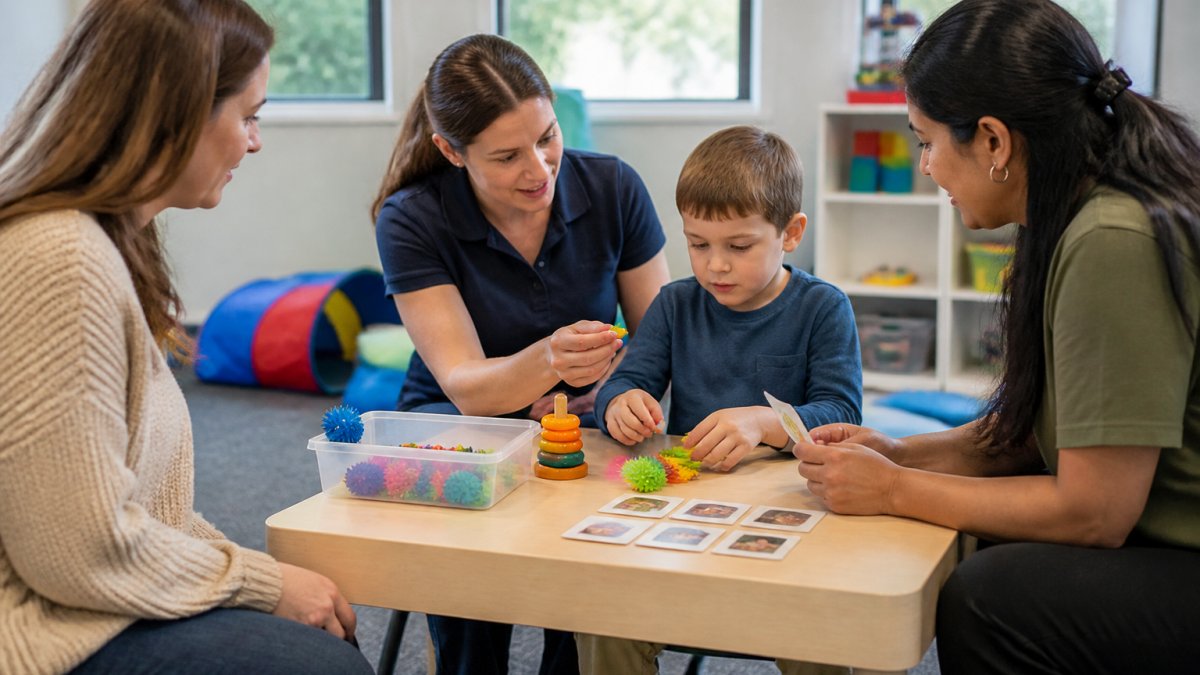
Consider a child who cannot yet ask for a break. The speech therapist builds the requesting language. The occupational therapist builds the ability to notice rising sensory load and use a calm-down plan. Neither piece works alone.
The same applies to play skills, feeding and handwriting, where regulation, motor control and language all meet. Joint goals between professionals can help avoid separate plans that do not coordinate with each other.
Watch out: the biggest mistake we see is commissioning two therapists who never communicate. Ask both to share goals in writing.
How to Choose Therapy for an Autistic Child: A Practical Decision Guide
How to choose therapy for an autistic child comes down to one question: what is actually blocking your child's day? Most ranking articles stop at defining each discipline.
Work through the prompts below honestly, and note which ones describe your child most days rather than on a bad day.
- Your child cannot express basic needs (hunger, pain, needing the toilet) and becomes distressed when not understood → raise speech and language therapy first, and ask specifically about augmentative and alternative communication (AAC) options such as picture exchange or a communication app.
- Your child understands instructions but cannot organise their body to follow them (cannot get dressed, hold cutlery, or sit through a meal) → raise occupational therapy first, and ask about a sensory and motor assessment.
- Your child is overwhelmed by noise, textures, or busy spaces and this limits where you can go as a family → raise occupational therapy, and ask how sensory accommodations could be trialled at home and school before any therapy begins.
- Your child speaks fluently but conversations break down (turn-taking, repairing misunderstandings, knowing when a comment lands badly) → raise speech and language therapy, and ask about social communication goals that focus on mutual understanding rather than masking.
- Both communication and sensory or motor needs are significant → ask for both, and ask each professional to share written goals with the other so they do not duplicate or conflict.
- School participation is the sticking point → ask about support delivered in the classroom, and whether the therapist can observe your child in that setting rather than only in a clinic.
- You are unsure → request an assessment and ask each professional what they would prioritise and why.
A neurodiversity-affirming approach matters here. A neurodiversity-affirming approach focuses on removing barriers so an autistic child can take part in the life they want.
For families weighing up the first step, our article on when should my child see OT sets out the signs that extra support could help.
Watch out: a common pattern is for families to be offered whichever service has the shortest waiting list rather than the one that matches the primary need. Ask explicitly what the referral is for and what the therapist will assess.
Accessing Therapy, Assessments and Reviewing Progress
Accessing therapy usually starts with a conversation with your GP, health visitor or school special educational needs co-ordinator (SENCO), who can advise on referral routes. Waiting times vary by area.
An assessment should cover strengths as well as needs. You should leave knowing what was observed, what the goals are, and who does what. Concrete questions to ask include:
- What did you observe, and in which settings?
- What are the proposed goals, and how were they agreed with us?
- How will my child's views and consent be taken into account?
- Which goals matter most in everyday life, and which are lower priority?
- Who will deliver the support, and how often?
- How and when will we review progress?
Review progress against those goals, not against vague impressions. Ask:
- Has the goal been met, partly met, or not met?
- What has changed at home and at school?
- Is my child communicating more functionally, participating more, or experiencing fewer barriers?
- Does the plan need adjusting?
A useful way to think about progress is to look at participation and independence rather than compliance.
Where both therapies are involved, ask for a shared review so goals are coordinated rather than duplicated. A short joint conversation between professionals, even by phone, can help prevent conflicting advice.
Watch out: if you are told there is no capacity for review, ask when the plan will next be looked at and who to contact if things change. A plan without a review date tends to drift.
Discuss Your Child's Needs With a Community-Based Occupational Therapist
Choosing between occupational therapy versus speech therapy for autism rarely means choosing one forever. It means starting where the need is greatest and building a team around your child.
Life-OT provides community-based occupational therapy for children, young people and adults, with specialist sensory integration interventions and personalised plans. Its multidisciplinary approach combines occupational therapy with sports therapy and nutrition, and it has over 20 years of experience.
Not sure where to begin? Get in touch with Life-OT to discuss your child's needs and agree a plan that fits your family. If you would like to know more first, read what a community occupational therapist does.
Frequently Asked Questions
What is the difference between occupational therapy and speech and language therapy for autism?
Occupational therapy focuses on sensory processing, motor skills, self-care and everyday participation, such as dressing, feeding and handwriting. Speech and language therapy targets communication: expressive and receptive language, speech sounds, social communication and alternative and augmentative communication. In practice the two overlap heavily, because a child who cannot regulate sensory input often struggles to communicate, and a child who cannot communicate often withdraws from daily activities. Many autistic children benefit from both.
Can a child have occupational therapy and speech therapy at the same time?
Yes. Occupational therapy and speech therapy together is common and often recommended. When therapists coordinate, goals reinforce each other: sensory strategies used in OT sessions can support attention during speech sessions, and communication supports can make self-care routines easier at home. Ask each therapist whether they are willing to share goals and review progress jointly.
How do I choose the right therapy for my autistic child?
Start with the goal that matters most to your child and family right now. If the main difficulty is communication, requesting, understanding language or social interaction, speech and language therapy is the natural first step. If the main difficulty is sensory regulation, motor skills, feeding, dressing or participation in daily routines, occupational therapy for autistic children is likely the better fit. Many families need both. Ask what happens in an assessment, how goals are agreed with you, and how progress will be reviewed, then check waiting times and eligibility through your local health board or local authority.
Can speech and language therapy support non-speaking autistic children?
Yes. Speech and language therapy for autism is not only about spoken words. Therapists support functional communication in whatever form works for the child, including gestures, signing, picture exchange systems and alternative and augmentative communication devices. The aim is that the child can express needs, make choices and take part in social interaction. A therapist will usually assess receptive language and social communication as well as speech sounds, then build goals around the child's strengths and needs rather than a single expected pathway.
The challenge is knowing which therapy to pursue first and who should be talking to whom. Life-OT can help you map that out, with specialist sensory integration interventions, personalised plans and a team that stays in contact between sessions. Get started with Life-OT and give your child support that fits their actual day.